You are browsing the General category


Exhibitions: Modern Makers & Model:Making – Ptolemy Mann

Ptolemy Mann


Ptolemy Mann
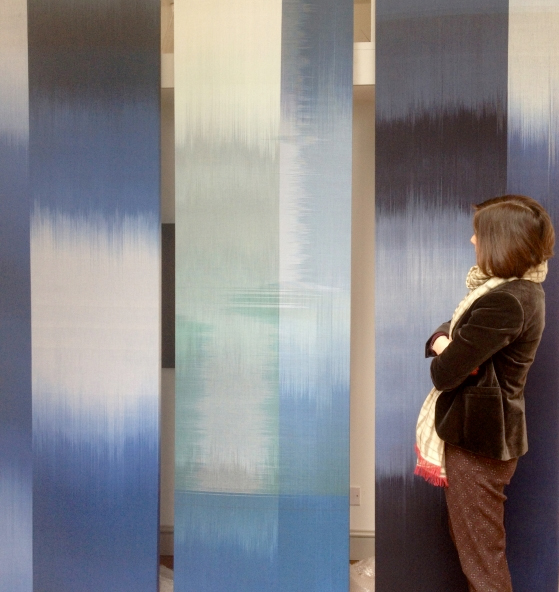
will  be showing as part of the exhibition Modern Makers at Chatsworth House this September. Curated by Sarah Griffin and presented by Sothebys, it’s a selling exhibition of contemporary applied art across several disciplines. Exhibitors were invited to make work in direct response to the house and its collection in some shape or form. After several visits Ptolemy created an installation of nine 250 x 70cm artworks called Chromatogenous  (meaning ‘to generate colour’). Dates: 18th September – 23rd December 2013

Each artwork represents a single colour (from left to right; Ultramarine : Aquamarine : Indigo) that is in some way significant within the house and textile archive at Chatsworth.

Each piece is an exploration of deep emotive colour and will be shown in sequence on a long wall within the New Gallery. More details can be seen here.

Continue reading →

Juried Exhibition: Complexity 2014 – call for entries

complexity logoComplex Weavers announces its biennial international juried exhibition ‘Complexity 2014’ featuring works employing complex weave structures interlacing threads and fibers in ways beyond plain weave.

Complex weaving is defined by the cloth produced and the mind it took to create it, not by the equipment used. There is no requirement that the work must be woven on a minimum number of shafts or on a Jacquard loom. Works with historic inspiration and interpretations, as well as non-loom interlacements such as ply split braiding, kumihimo and tablet weaving are welcome.

Eligibility: All Complex Weavers members and students at accredited colleges and universities may submit entries. Non-member artists may join Complex Weavers www.complex-weavers.org by the submission date and submit entries. Students must provide proof of full-time current registration. Students are not required to be members of Complex Weavers. All entries will be evaluated by three jurors.

Each artist may submit three works. All work must be original, not executed under supervision and completed after July, 2012. Weight of each work must not exceed 25 lbs (11.4 kg) including hanging and display hardware per work.

Submissions must not have been previously published in any printed publication or national exhibit prior to submission. Accepted works must remain for the duration of the exhibit (August 1, 2014).

The exhibition: Complexity 2014 will travel to three locations in 2014: University of Nebraska, Lincoln NE, Hotel Murano, Tacoma WA and Brown University, Providence RI. Entry is easy via email and review fees may be paid through PayPal.
Entry deadline is November 18, 2013. Entry Form is available here
Continue reading →

Publication: Digital Jacquard Design – Julie Holyoke

Digital Jacquard Design AW 8


Digital Jacquard Design. For centuries, the creation of Jacquard cloth required the collaborative efforts of teams of designers and technicians working on vastly complex equipment. In the past three decades, developments in loom technology and CAD systems have made it possible for a single individual to design and produce this most challenging class of textiles.

Digital Jacquard Design presents a comprehensive introduction to the creation of weave patterning in the era of digitally piloted looms. It offers both aesthetic and technical training for students of figured weaving, covering the Jacquard medium in fantastic breadth and depth.

The book is an essential guide for all who create figured textiles with modern materials and tools, and provides the reader with a ‘digital’ key to access and employ the great textile traditions of the past.

Digital Jacquard Design examines the design process from end to end, progressing from visual analysis, sample analysis and weave-drafting methods, to figuring techniques and the selection and building of weaves. It provides a guide to converting traditional drafts to digital polychrome format, a design terminology and a weave glossary. The book concludes with a rich set of case studies to demonstrate ingenious and effective weave and design solutions.

Publication date Oct 10th 2013

Julie Holyoke  is a textile designer for hand loom and industrial production; she teaches CAD textile design in Italy at the Lisio Foundation and abroad.

Text: Bloomsbury Publishing

New Designers: Stephanie Rolph selects 5 weave designers

Stephanie Rolph was asked to select her 5 favourite weave designers at New Designers 2013. Stephanie recently  graduated from Central Saint Martins, BA (Hons) Textile Design and is about to commence an MA in Woven Textiles at The Royal College of Art

Aston Bradley

www.astonbradley.wordpress.com/
Aston’s collection, ‘Aqua Abyss’, was inspired by the reactive qualities of jellyfish, coral reefs and sea anemones. A refreshing take on sea-inspired projects, her work focused on creating fabrics that reacted to changing environments. Combing natural and synthetic reactive yarns in particular structures she was able to create a strong collection of weaves with a beautiful depth and movement created by the shrinking and stiffening of yarns.
Images: Aston Bradley

Anna Piper


An MA Design Innovation student at Nottingham Trent (completion Oct 2013), Anna’s collection focused on the process of woven textiles design and production for fashion. Her work is visually striking with strong geometric forms and a monochromatic colour scheme accented with a vivid red. Her work strives to create “single component garments” and through her research into doing this she has created a striking collection of technical fabrics that form a cross over between technical sports fabrics and woven heritage pieces. www.annapiper.net/#
Images: Anna Piper

  Continue reading →

Exhibition: Tomorrow There is No Recording & weave workshop

nickrelph_1Chisenhale Gallery in Bow, London presents a solo exhibition by London born, New York based, artist Nick Relph who works across video, drawing and installation. This commission of an entirely new body of work will be his first major solo exhibition in a public institution following his ten-year collaboration with Oliver Payne (1999-2009).

Tomorrow There is No Recording examines handicraft, materials and ideas of value and exchange, and the relationship of industrial processes to contemporary economic models. Using a four-harness floor loom, Relph has fabricated a series of small weaves using materials including polyester, rayon, silk, monofilament, latex and paper. The weaves are presented at Chisenhale as part of a specially conceived installation.

Relph’s interest in handmade, woven textiles stems from an appreciation of the labour involved in their production, in addition to the particular formal and material resonance of these constructed fabrics within our digitally-oriented culture. Woven surfaces can be read as images, whilst also retaining the information of their making – mistakes and irregularities or impressions from the loom – and the signs of wear that emerge over time and through use. This preoccupation with the relationship between image and surface emerges from Relph’s previous film and video work. He has said: ‘I can’t think about moving image now without thinking about this surface upon which it’s being viewed’.

Relph first began to explore his interest in the material and social effects of textiles through moving image. Thre Stryppis Quhite Upon ane Blak Field (2010) – presented at the Venice Biennial 2011 and currently on display at Tate St Ives – connects the meandering history of tartan with the Japanese fashion label Comme des Garçons and the artist Ellsworth Kelly. Here, Relph employs a trilogy of colour – red, blue and green – as a visual motif and conceptual device to weave associations between subject matter in the film. The history of colour reproduction, manufacture and consumption are further explored through the presentation of the film as a composite RGB projection, which recalls the mechanical print processes used in the textile industry.

Continue reading →

Workshop: Bhakti Ziek. Multi – weft weave structures for jacquard

Blue_Song_2_DetailBhakti Ziek, co-author of The Woven Pixel: Designing for Jacquard and Dobby Looms Using Photoshop©*, will conduct a six day masterclass in Scotland on multi-weft weave structures using the colourbothy studio Thread Controller 1 (TC1). This class will be limited in size so structures can be studied in depth and everyone will have time weaving on the TC1.

While jacquard weavings can exhibit imagery and great detail using one warp and one weft, such as traditional damasks, using multiple wefts and/or multiple warp systems allows a visual appearance of many colors across one horizontal line of the cloth. Ziek will take students through a study of taqueté and samitum (both weft-faced structures), lampas, weft-backed structures, and double cloth (using more than two wefts).

Students can work with one image developed in all these structures, allowing a great comparison of visual nuances, or use different images for each structure. Or they can choose to focus on just some of the structures that are most relevant to their own needs. The class is small so personal attention will be paid to the individual and their needs. Continue reading →

Exhibition: British Tapestry Group

weaveshed british tapestry group York 4


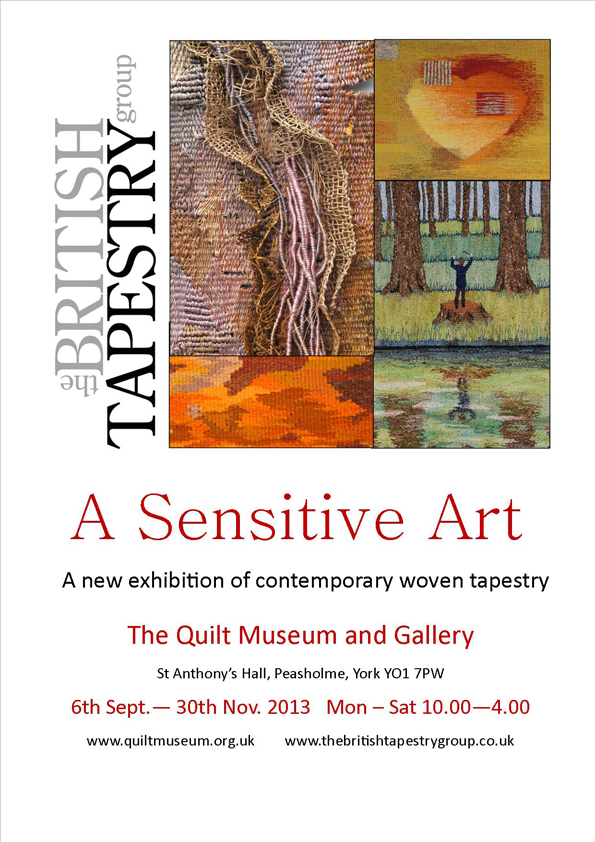
The exhibition features work by 48 members of the BTG. The diverse works in the exhibition explore the theme of a sensitive touch. Samples are provided for handling and some pieces have been specifically made to be touched.

For more details visit
www.quiltmuseum.org.uk
www.thebritishtapestrygroup.co.uk

Amateur weaver required for TV production company

Ricochet (The Weave Shed)(1)Independent TV production company Ricochet has recently been commissioned to make a new series for one of the UK’s Major Broadcasters celebrating traditional and contemporary crafts.

They are currently on the lookout for the country’s most gifted amateur craftspeople to take part in a unique programme that will hone their skills and hopefully support them to become masters of their crafts. The crafts they aim to feature include; Pottery, Blacksmithing, Stonemasonry, Weaving, Glass and Cabinet making.

These craftspeople will be mentored by some of the UK’s top professionals from a variety of disciplines as apprentices on an intensive training scheme. At the end of each training period the apprentices will have the opportunity to create a final piece which will be judged by the leading craftsmen and women in these fields. One apprentice will be claimed the best and will hopefully get the opportunity to turn their passion into a career.

If in the instance your skills are too professional, please do think of any emerging and enthusiastic individuals breaking into the world of textiles.

To find out more information regarding this series, please contact Adam on 01273 224 837 / crafts@ricochet.co.uk

eTextiles Summer Camp: Priti Veja

eTextiles summer camp montage2 LowResIn July 2013 the eTextiles Summer Camp event took place in Paillard, France, generously hosted by Paillard Centre d’Art Contemporain & Résidence d’Artistes and meticulously organised by Mika Satomi and Hannah Perner-Wilson of Kobakant. The location of a French countryside village, in an old secluded 18th century paper mill was perfect for such an event.

This five day event bought together an international mix of some of the most involved and enthused e-textile practitioners working in areas such as design, art, research, professional industry, academia and computing. The full schedule consisted of a lot of e-textiles thinking, doing, making, talking and sharing, based around the theme of the event – ‘soft and slow e-textiles’. The focus was on making processes involving time intensive craft methods and hand making in collaboration with new technologies.

Continue reading →

Exhibition: A Field of Cloths

Ikat_5 for web thumbnail The London Guild of Weavers, Spinners and Dyers is holding a textile exhibition: A Field of Cloths – An exhibition of handspun & handwoven textiles inspired by Africa, China and India at St Martin-in the Fields, London

Inspired by the commitment of the church to its outreach work in the wider community and its worldwide connections the Guild’s exhibition reflects the designs, techniques, colours and fabrics of China, Africa, India, and Asia. Each piece will be accompanied by an explanation of the original inspiration; such as yarns, i.e. silk, bamboo, camel, the vibrant colours of Africa and India and dyes from around the world.

The exhibition is being held in The Gallery in the Crypt of St. Martin-in-the-Fields
Dates: 20th August -15th September 2013
Free admission – open daily 11.am-6pm.
There will be handmade items for sale.

Guild information.
The London Guild was founded in 1950 and has around 150 active members. They share an interest in hand spinning, hand weaving, dyeing, design, and textiles in general, and membership is open to anyone interested in these crafts. The members are active in producing textiles, both for personal use and commercially, and they also provide training programmes and support others in the understanding and practice of their crafts. As part of the aim of the Guild to promote awareness of and education in these crafts, they hold a biennial exhibition of members work which this year is at St Martin-in-the-Fields. Guild members give demonstrations of weaving and spinning at events such as the recent Silk Day in Spitalfields celebrating the history of the Huguenots in London.
Continue reading →