You are browsing the General category


Ann Richards – Weaving Textiles That Shape Themselves

Just add water -  textiles that shape themselves

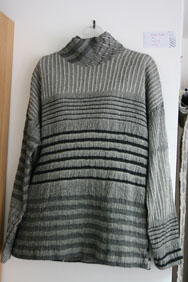
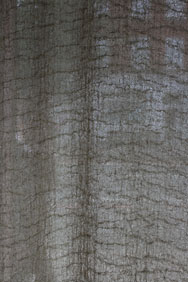
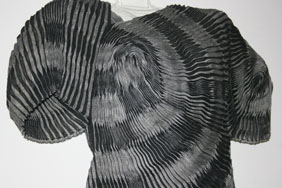
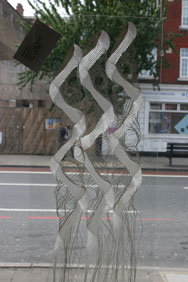
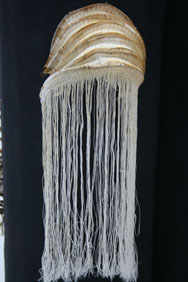
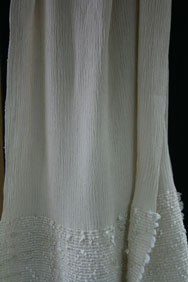
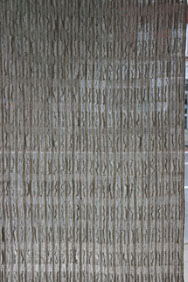
Weaving Textiles That Shape Themselves sounds like a contradiction in terms, but this sets out to show how textiles can do precisely that: shape themselves. Good design, in any medium, cannot simply be imposed – it depends also on what materials and structures can do. The designer may choose what elements to put together, but their subtle interplay will determine what happens, sometimes in surprising ways. Woven textiles show this ’self-organizing’ tendency to an extreme extent, especially when there are strong contrasts of material and structure. Textures emerge during wet finishing, as fibre, yarn twist and weave structure interact. The most dramatic effects are possible with high-twist (crepe) yarns and these form the main of the book.

Crepe yarns can create their three-dimensional effects because the stress of the spinning process gives them a lot of energy. This is released when the fabric is washed – as water is absorbed, spiralling movements of the yarns form crinkles and pleats, giving highly textured, elastic fabrics. Yarn twists and weaves can also be varied across the fabric, so rectangular pieces change shape when washed. ‘Loom-to-body’ clothing, needing minimal cutting and sewing, can emerge from a simple change of yarn or structure – textiles really can shape themselves.

Textiles by a variety of designers and artists are included – Junichi Arai, Reiko Sudo, Ann Sutton, Lotte Dalgaard and many others.

The book is published by Crowood Press (www.crowood.com) Price: £25.

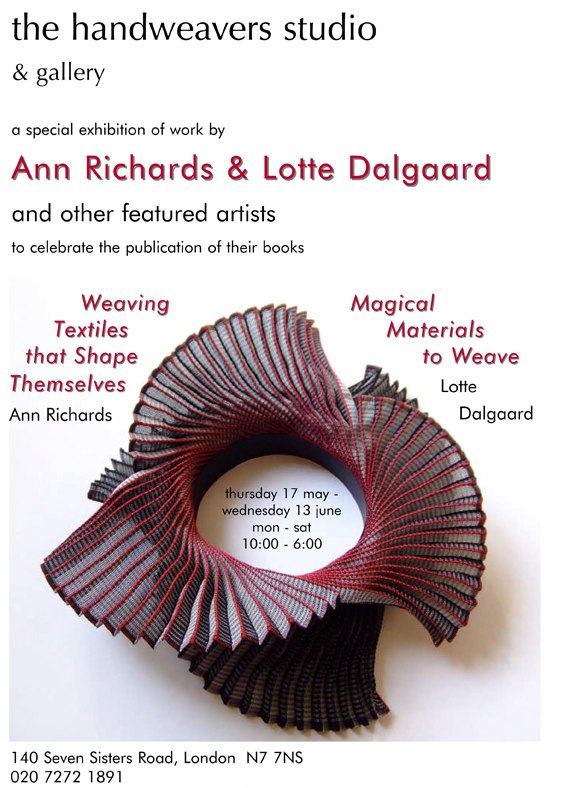
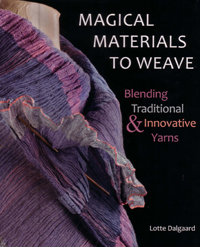
There will be a book launch/exhibition at Handweavers Studio in London on Thursday 17th May 2012. This will be a joint event with Lotte Dalgaard, whose book “Magiske Materialer” (published in Danish in 2006) will come out this year in an English Edition (“Magical Materials To Weave”). Textiles included in both books, together with new work, will be on display.

Handweavers Studio and Gallery
140 Seven Sisters Road
London N7 7NS

For details of the location and more information about this event see the website: www.handweavers.co.uk

Exhibition & New Books: Ann Richards & Lotte Dalgaard


info@thehandweavers.co.uk
www.handweavers.co.uk/


Textiles: Guild / Education Exchange Grants

The Journal for Weavers, Spinners & Dyers is pleased to announce a new grant scheme to foster the exchange of skills and knowledge between Guilds of Weavers, Spinners & Dyers and UK Universities and Colleges involved in textiles.

Today’s textile students are all potentially future Guild members and Journal readers. They can benefit from the considerable expertise that Guilds have to offer. Equally, Guilds can get an insight into current issues and trends in textile design through engagement with educational institutions and their students.

Although applications will only be accepted, and funding provided, via Guilds that are members of the Association of Guilds of Weavers, Spinners & Dyers, we are keen to make Universities and Colleges with textile departments aware of the scheme so that they can form or strengthen their links with local Guilds and consider what sort of activity might be mutually beneficial.

Further details
Guilds will be invited to apply for a grant from the Journal for educational work to cover expenses such as travel, materials and tutors’ fees.
In total, the Journal has up to £500 in grants available, which could potentially support a number of projects.

Proposed activity might, for example, include
• Demonstration and discussion of specific weaving techniques with examples from staff, students and Guild members.
• A spinning demonstration and workshop provided by the Guild for students. A talk for the Guild by students on some of the yarns, materials and processes they have been using.
• A one-day workshop on a specialist dye technique for Guild members and students using expertise from the Guild and facilities at the university. Techniques might include use of natural dyes, warp painting, ikat, wax resist and so on.

These are just examples however: we expect proposals that are relevant to the particular interests and skills of Guilds and the educational institutions they will be working with. The proposed activity must take place during the period February – June 2013.

If you don’t already have Guild contacts, you can find a list of Guilds at
www.wsd.org.uk/guilds.htm

Information about the grants scheme and how Guilds can apply will be published in the Autumn issue (243) of the Journal.

The Journal is the magazine of the Association of Guilds of Weavers, Spinners & Dyers. Published quarterly, it covers a wide range of textile subjects, including articles on historic textile techniques and cutting edge modern design. We offer reduced subscription rates to both educational institutions and individual students.
www.thejournalforwsd.org.uk/

TextileMatters: Structure & Surface


Images L-R: Ann Richards; Jun Tomita; Lotte Dalgaard; Ptolemy Mann, Lotte Dalgaard; Ptolemy Mann; Ann Richards

A Bath School of Art & Design, Textile Research Centre symposia event
Celebrating international contemporary woven textiles practice

Speakers: Ann Richards (UK) / Lotte Dalgaard (Denmark) /
Ptolemy Mann (UK/US) / Jun Tomita (Japan)

Coinciding with a number of exciting publications and exhibitions by these four leading international weavers, this mini-symposium will celebrate very personal yet inter-related approaches to woven textiles practice – From deep research into material and structure to create textured and shaped cloths, to the extensive use of traditional and evolved dying and colouring techniques for contemporary applied art and design.

In conjunction with The Handweavers Studio & Gallery (London), the event will include book signing of new titles by the speakers, as well as the chance to purchase specialist weaving materials. Chrome Yellow Books will also be offering a fantastic range of textile and related titles.

Convened by Tim Parry-Williams, Senior Lecturer Textiles [Woven], Bath School of Art & Design, this is the inaugural event of the new Textile Research Centre at Bath Spa University’s Corsham Court Campus.

Date: Saturday 19th May 2012, 10am – 4pm
Location: Bath Spa University, Corsham Court, Corsham, Wilshire, SN13 OBZ

Tickets (to include light lunch and morning/afternoon refreshments):
Full rate £45 / Students (NUS registered) £20

Booking (BY MONDAY 14TH MAY):
Contact: Adele Milton (Bath School of Art & Design, Reception)
Tel: 01225-875533 or Email: a.milton@bathspa.ac.uk

Local information – Bath Spa University, Corsham Court Campus webpage:
www.bathspa.ac.uk/services/corsham-court-centre/

Travel to Corsham:
By rail – Chippenham (nearest) / Bath Spa + Taxi (bus services from Bath Spa)
By car – Public car parks in the town a short walk from the Court campus

Recommended accommodation:
Corsham – Guyers House www.guyershouse.com/
Bath – Holiday Inn Express www.guyershouse.com/
Bath – Hilton www1.hilton.com/en_US/hi/hotel/BATHNHN-Hilton-Bath-City-hotel-/index.do

Woolmark Relaunches ‘Cool Wool’ for Summer – Philippa Watkins

Visitors to Première Vision could’nt resist a smile at the (by now iconic) Woolmark image of a flock of stylishly ‘cool’ Merino sheep in Ray-Ban shades, which met them at the entrance.

The image really set the scene, for the re-launch of Cool Wool, drawing buyers and designers to the wealth of lightweight wools on show, and putting wool firmly back on the map as an elegant, yet functional fabric for spring garments, which keeps cool in hot weather. Merino wool’s natural breathable and thermal-management properties really do make it highly suitable for warmer climates.

This is all part of the efforts to bring wool back into favour, after many years when all promotional activity of woollen products had been stopped.  Wool, without promotion had a difficult time losing a lot of its market share, despite the many new developments which had brought finer softer merino wools in knitwear and wovens – which just proved how important marketing is.

Now ‘The Campaign for Wool’ www.campaignforwool.org is making up for lost time, and AWI (Australian Wool Innovation) is putting huge efforts into rebranding wool.  The Cool Wool relaunch is one such promotion to inform what wool can be. Another is the Woolmark Company’s new “Wool Lab” project, which is a seasonal guide to the best wool fabrics and yarns, which is proving to be an extremely effective tool, identifying inspirational wool trends for the fashion industry, including brands, retailers, manufacturers, spinners and weavers. It’s well worth getting your Ray-Bans on to have a look…..

VSO Opportunities for Textile & Design Lecturers

VSO is the world’s leading independent international development organisation that     works through volunteers to fight poverty in developing countries. VSO’s high-impact approach involves bringing people together to share skills, build capabilities, promote international understanding and action and change lives to make the world a fairer place for all.

VSO has been working in Ethiopia since 1997. The work of VSO Ethiopia focuses on education, working through volunteering and partnership to empower individuals and communities to realise their potential for positive and lasting change. Currently they have two vacancies for textiles and garment teaching professionals to work in Ethiopia for 12-24 months. These roles are based in the major universities in Ethiopia. Each role requires a specialist with at least 2 years of experience teaching in a higher educational institute as well as post-graduate qualifications (or equivalent) in the subject taught.

These are voluntary placements and VSO will ask you to commit to 12-24 months in order to make a sustainable change and impact to development. In return VSO makes sure their volunteers are supported and their volunteer financial package includes a local living allowance, return flights, accommodation, medical and travel insurance cover, national insurance contributions, visas and work permits and guaranteed holidays.

Please see below short summaries of each of the individual roles:

Professor for Textile Technology (textile testing and finishing), Bahir Dar, 24 months
You’ll be based at the Bahir Dar Institute of Technology and the Institute of Textile, Garment and Fashion Design working with institute staff to contribute to the improvement of the education system and university-industry partnerships. You will work with staff to develop a new curriculum and all aspects of the teaching programme for the MSc, conduct research and write funding proposals. You will also do staff training to build capacity and support the change process. You’ll have a masters or equivalent in textile technology as well as experience of teaching and training. You’ll have experience of conducting research and ideally will have professional industry experience. You’ll need to be an excellent communicator and have a flexible and proactive attitude towards work. (To apply for this role please quote Job ref: ETH0534/0003/0001).

Professor of Garment Technology, Bahir Dar, 24 months
You’ll be based at the Bahir Dar Institute of Technology and the Institute of Textile, Garment and Fashion Design working with Institute staff to contribute to the improvement of the education system and university-industry partnerships. You will work with staff to develop a new curriculum and all aspects of the teaching programme for the MSc, conduct research and write funding proposals. You will also do staff training to build capacity and support the change process. You’ll have a masters or equivalent in garment technology as well as experience of teaching and training. You’ll have experience of conducting research and ideally will have professional industry experience. You’ll need to be an excellent communicator and have a flexible and proactive attitude towards work. (To apply for this role please quote Job ref: ETH0534/0002/0001).

Apply online at www.vso.org.uk/volunteer or email elizabeth.bowen@vso.org.uk for more information.

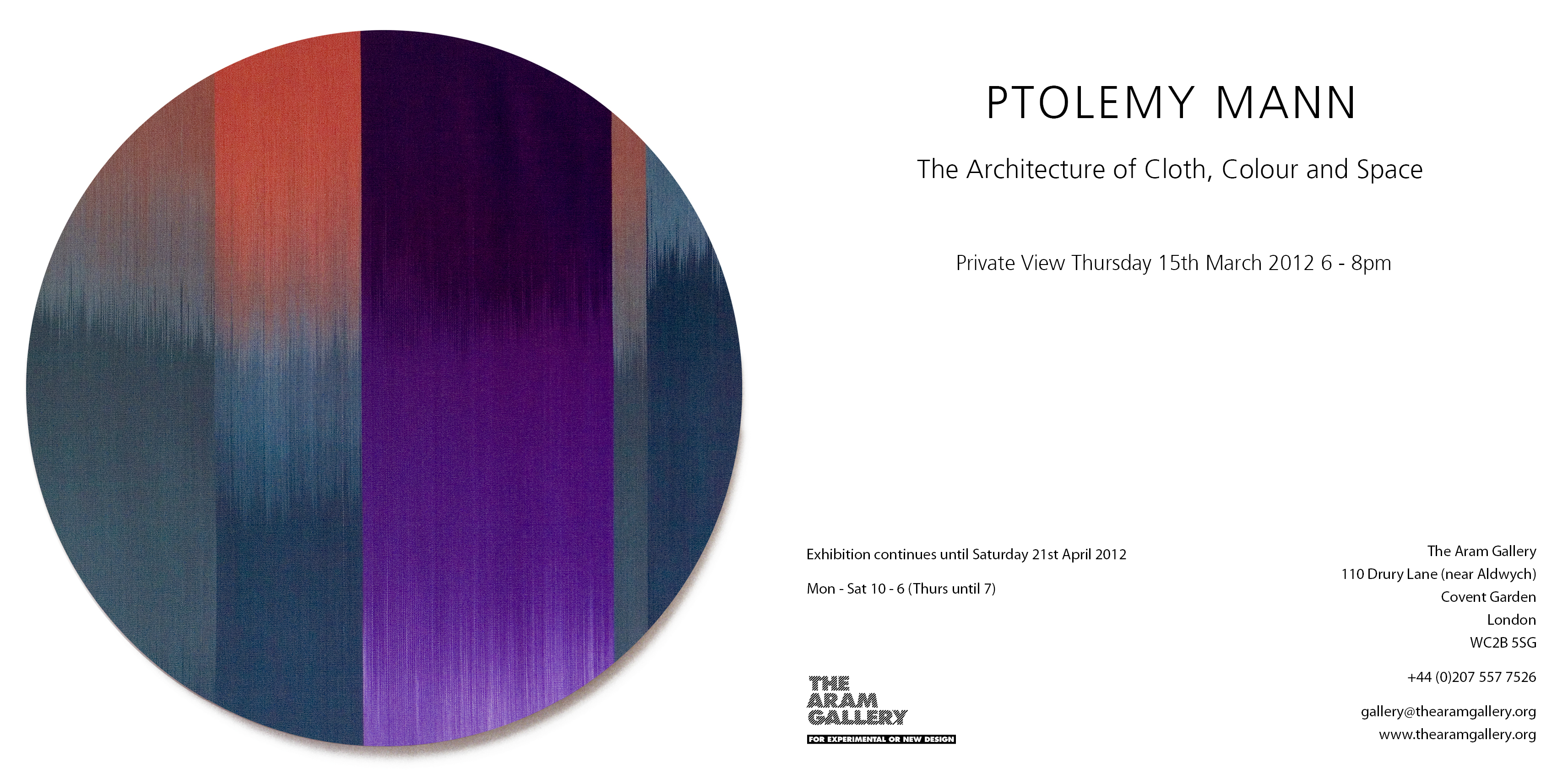
Ptolemy Mann – The Architecture of Cloth, Colour and Space

WOVEN TEXTILE ART – COLOUR CONSULTANCY – TEXTILE DESIGN   2012

Ptolemy Mann currently has a solo exhibition at The Aram Gallery until April 21st 2012.

Mann has been running her textile art and design studio since 1997. After graduation from Central Saint Martins and the Royal College of Art she has established herself as the unique creator of one-off woven architectural art panels. Her ability to encompass the fields of Design, Art, Architecture and Craft equally has enabled the development of a varied and dynamic working practice.

Mann has recently developed an IKAT COLLECTION of commercial textile designs for furnishing fabrics and fashion. This portfolio shows geometric repeated pattern designs inspired by her existing one off art pieces; the intention being to evoke a hand-made quality and blending of colour in the more commercially viable form of woven and digitally printed fabric production. She has collaborated with Christopher Farr to license a range of flat woven rugs and a digital print linen called Adras. Other collaborations are currently in development with John Lewis PLC, Ercol Furniture, Linenhouse and Studio Levien. In March 2011 she was awarded with the Homes and Gardens best Fabric Designer Award.

Ptolemy Mann offers a colour consultancy service to architects and interior designers across a wide range of projects with a specialism on external healthcare facades.

She exhibits and lectures regularly throughout the UK and abroad and currently has a touring solo show called ‘The Architecture of Cloth, Colour and Space’ travelling the British Isles. She writes regularly for the textile magazine Selvedge and has been a member of the GLOBAL COLOUR RESEARCH UK Colour trend prediction panel. In 2009 she curated the exhibition ‘Significant Colour’ at the ARAM gallery in London.

Clients include NHS, Hilton Hotel group, GlaxoSmithKline, The Open University, Cunard, KPMG, Savills, Derwent London, Building Better Health, Land Securities Swankye Hayden Connell Architects and Stanton Williams Architects.

Ptolemy Mann shows at Contemporary Applied Arts, is a regular exhibitor at the Chelsea Craft Fair, ORIGIN, 100% Design, SOFA New York and Chicago and is a selected maker on the Crafts council register.

All images copyright Christina Theisen. With thanks to Ptolemy Mann for the post.

www.ptolemymann.com

www.significantcolour.wordpress.com

Continue reading →

The Peter Collingwood Trust – Award Application

Alastair Morton and Edinburgh Weavers: Visionary Textiles and Modern Art

Lesley Jackson

Artist and designer Alastair Morton (1910-1963) was an inspirational figure who crossed the divide between painting and textiles. As the director of Edinburgh Weavers – one of the most innovative textile companies of the twentieth century – he spearheaded a range of artists’ textiles that remain unparalleled in quality and scope. Specialising in printed and woven furnishing fabrics, Edinburgh Weavers’ collections featured designs by major figures such as Ben Nicholson, Barbara Hepworth, Cecil Collins, William Scott, Alan Reynolds, Keith Vaughan, Elisabeth Frink, Marino Marini and Victor Vasarely.

In all, Edinburgh Weavers collaborated with over a hundred and fifty artists and designers from 1931, when Morton joined the firm, until his death in 1963. As well as nurturing the talents of fellow artist-designers, such as Marion Dorn, Ashley Havinden, Humphrey Spender, Lucienne Day and Hans Tisdall, Morton designed many innovative textiles, both for Edinburgh Weavers and Horrockses. A close friend of Ben Nicholson and Barbara Hepworth, Morton was also a gifted artist himself. His Constructivist paintings and subtle abstract watercolours deserve to be better known. This book records the fascinating career of a multi-talented individual and his heroic endeavours at Edinburgh Weavers as a champion of artists’ textiles.

Lesley Jackson is a writer, curator and design historian specializing in twentieth-century design. Her books include The New Look: Design in the Fifties (1991), ‘Contemporary’ Architecture and Interiors of the 1950s (1994), The Sixties: Decade of Design Revolution (1998), Robin and Lucienne Day (2001 / 2011) and 20th-Century Pattern Design (2002 / 2011).

Publication date: 14 February 2012


Pitti Filati Report – Philippa Watkins

Pitti Filati raises spirits

Yarn fair Pitti Filati was a joy – designed to lift the spirits with fresh colours and lots of creative ideas for summer – despite the extreme difficulties brought by savage competition for spinners from the Far East, and more recently the massive EU debt crisis. But hard times brings out the best, and those spinners who’ve survived the competitive onslaught, were pulling out all the creative stops. Extraordinary technical advances as well as the spur of competition has resulted in enormous creativity as spinners look to go upmarket.

And things ARE changing, as buyers once again look to Europe for production, both of yarns and knitwear – (also happening in the Scottish Borders knitwear industry), because buying only from China proves to be unwieldy, slow in delivery and too high on minimums. Besides, there’s a move towards buying closer to home (more sustainable) with smaller quantities of high value products.

And another helping hand is that European mills are now seeing the Far East NOT just as competition, but as potential markets for European produced fabrics. China it seems has an increasing appetite for luxury goods.

So for S/S 2013, it’s colour that is giving new collections excitement and inspiration, also combined with stitch. Colour becomes a form of expression, personalising in different shades, hues and contrasts, often multicoloured, giving knits newness, as knitwear continues a strong fashion trend. And what was striking were colour contrasts with lots of white – with 1970’s fluos, green, orange and acid yellow – or just black and white.

Linen and viscose are top choices for knitwear, notably also in mixes and blends. And of course cotton – but cotton prices have risen a lot, and uncertainty is slowing sales of cotton yarn. The soaring costs of all raw materials is clearly a big concern. In fact the only luxury fibre not rising unduly has been alpaca – resulting in more alpaca knitwear in the current winter season – and viscose prices have not risen unduly either.

This season sees a lot of fancy yarns, as spinners offer yarns with interest, rather than compete with classic qualities from the Far East. I’ve never seen so many tape or ribbon yarns, in every fibre, ranging from the finest cotton or silk tapes at Japanese Hasegawa (used apparently by Burberry), to cotton tapes from Filclass, rustic knitted linen tapes from Filpucci, and more fancy tapes in fibre mixes, often viscose, from Lineapiu, Millefilli, Olivo Filati, and others….. Tape yarns were also made from cutting knitted stripes, giving the yarn irregularity of colour, like a printed effect.

Also notable were crepe textures in fine high twist yarns, with a dry touch and drapey, in cotton, linen and viscose, a cool alternative to the smoothness of silk and viscose. And jaspe twist yarns in contrasting tones.

Yarns were mixed in knit stitch structures, mixing fancy yarns with classic, or thick yarns with thin. Extra effects are given in the twist of the yarn, for instance a ribbon yarn twisted with a contrasting colour.

There was a more rustic rural mood, working as a theme, focussing on honest values, and pride in workmanship. The trends area, entitled Futurural featured a line of agricultural workers, heads bowed in toil, each dressed in a patchwork of knits – with a nod to Amish quilts.

But it was a bit overdone, as it was’nt all rustic and rural. There was a strong sense of sophistication, in yarns and blends in silk, viscose and linen, carefully coloured and mixed with white in fluid drapey knits, which simply was not rural.

Colour inspirations

Colours for summer are fresh and delicious, taken from nature, water reflections, trees and more earthy tones of pigments and ochre mines. And achieved with multi colour mixes in the yarn or knit.

– Pale pastels: whitened, with lemony yellow and greens, coral, pale blues. – often in melanges (Todd & Duncan mixes white with tiny percentages of colour).
– Flowers: fresh mid tones, corals and yellows, pale orange, dappled greens and blues highlighted with lemon and lime.
– Toile de jouhy and indigo: mid tone blues, watery greens and turq, and white.
– Fresco: a soft palette inspired by frescos and plaster with irregular mid tones.
– Earthy: tones of pigments, ochres, clay and brown, with a Morrocan North African feel.

Dyeing Naturally

While on the subject of colour, it is possible now to dye with natural dyes on an industrial scale – Tintoria di Quaregna has fully developed its certified industrial scale dyeing with natural dyes. Produced with over thirty types of herbs and plants, such as Sandalwood, henna, blackberry, turmeric, indo, tansy and many others. Natural indigofera leaves following an ancient dyeing technique are used to achieve a natural indigo process. Needless to say it only works on natural fibres, and now with a Woolmark certification too.

The company also dyes in different forms and applied in different ways. A sprayed effect usually applied to fabric, when applied to a top or yarn gives a mottled effect which can be done to any depth or intensity. Vintage is another dyeing process which allows garments or yarns to have a used old look Stardust is a new finish which gives a bright starry effect and Make Up is a new finish applying a selection of make up powders to yarns, garment and fabrics.

Pages: 1 2