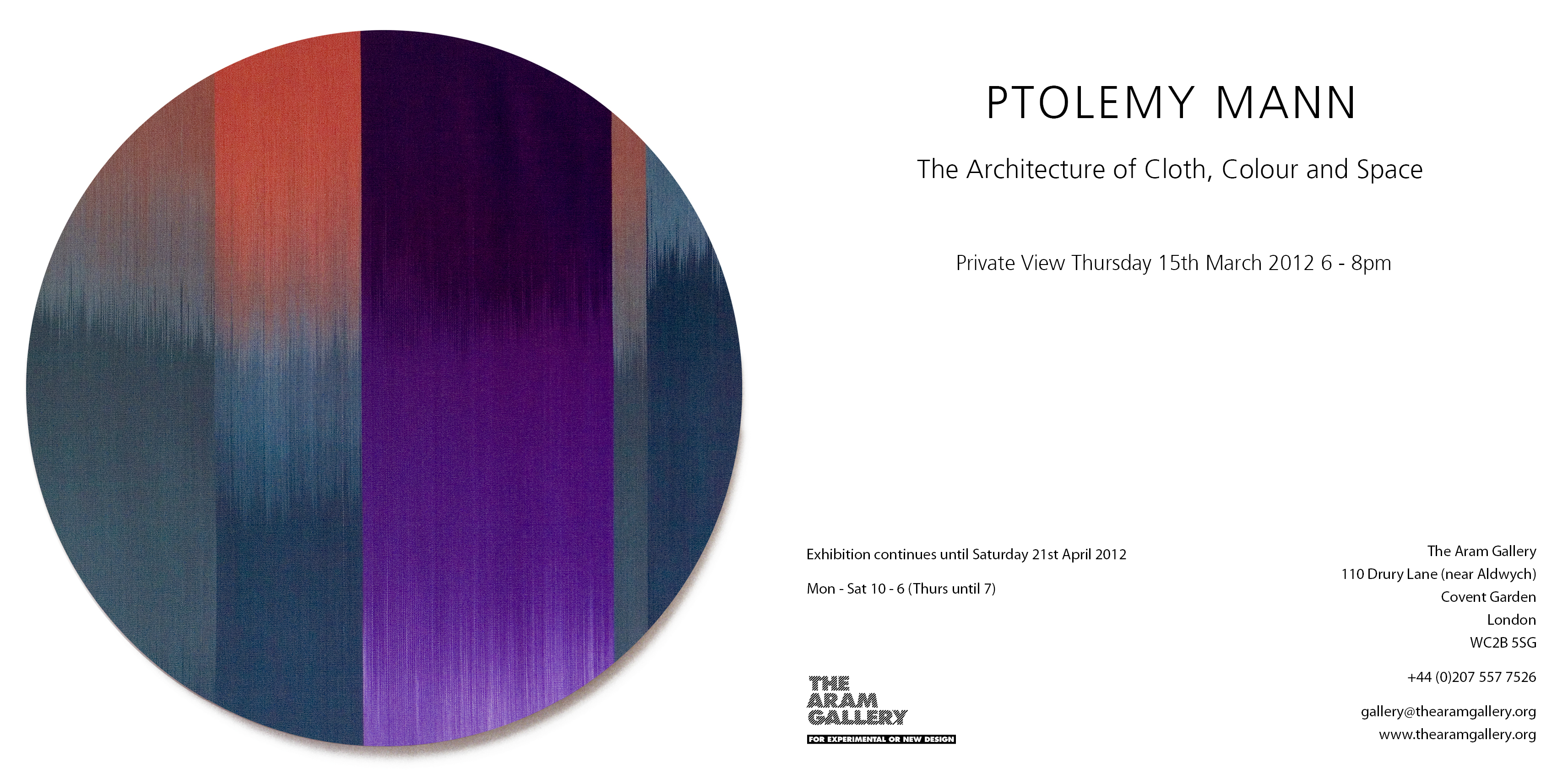
Ptolemy Mann – The Architecture of Cloth, Colour and Space

WOVEN TEXTILE ART – COLOUR CONSULTANCY – TEXTILE DESIGN   2012

Ptolemy Mann currently has a solo exhibition at The Aram Gallery until April 21st 2012.

Mann has been running her textile art and design studio since 1997. After graduation from Central Saint Martins and the Royal College of Art she has established herself as the unique creator of one-off woven architectural art panels. Her ability to encompass the fields of Design, Art, Architecture and Craft equally has enabled the development of a varied and dynamic working practice.

Mann has recently developed an IKAT COLLECTION of commercial textile designs for furnishing fabrics and fashion. This portfolio shows geometric repeated pattern designs inspired by her existing one off art pieces; the intention being to evoke a hand-made quality and blending of colour in the more commercially viable form of woven and digitally printed fabric production. She has collaborated with Christopher Farr to license a range of flat woven rugs and a digital print linen called Adras. Other collaborations are currently in development with John Lewis PLC, Ercol Furniture, Linenhouse and Studio Levien. In March 2011 she was awarded with the Homes and Gardens best Fabric Designer Award.

Ptolemy Mann offers a colour consultancy service to architects and interior designers across a wide range of projects with a specialism on external healthcare facades.

She exhibits and lectures regularly throughout the UK and abroad and currently has a touring solo show called ‘The Architecture of Cloth, Colour and Space’ travelling the British Isles. She writes regularly for the textile magazine Selvedge and has been a member of the GLOBAL COLOUR RESEARCH UK Colour trend prediction panel. In 2009 she curated the exhibition ‘Significant Colour’ at the ARAM gallery in London.

Clients include NHS, Hilton Hotel group, GlaxoSmithKline, The Open University, Cunard, KPMG, Savills, Derwent London, Building Better Health, Land Securities Swankye Hayden Connell Architects and Stanton Williams Architects.

Ptolemy Mann shows at Contemporary Applied Arts, is a regular exhibitor at the Chelsea Craft Fair, ORIGIN, 100% Design, SOFA New York and Chicago and is a selected maker on the Crafts council register.

All images copyright Christina Theisen. With thanks to Ptolemy Mann for the post.

www.ptolemymann.com

www.significantcolour.wordpress.com

Continue reading →

The Peter Collingwood Trust – Award Application

Alastair Morton and Edinburgh Weavers: Visionary Textiles and Modern Art

Lesley Jackson

Artist and designer Alastair Morton (1910-1963) was an inspirational figure who crossed the divide between painting and textiles. As the director of Edinburgh Weavers – one of the most innovative textile companies of the twentieth century – he spearheaded a range of artists’ textiles that remain unparalleled in quality and scope. Specialising in printed and woven furnishing fabrics, Edinburgh Weavers’ collections featured designs by major figures such as Ben Nicholson, Barbara Hepworth, Cecil Collins, William Scott, Alan Reynolds, Keith Vaughan, Elisabeth Frink, Marino Marini and Victor Vasarely.

In all, Edinburgh Weavers collaborated with over a hundred and fifty artists and designers from 1931, when Morton joined the firm, until his death in 1963. As well as nurturing the talents of fellow artist-designers, such as Marion Dorn, Ashley Havinden, Humphrey Spender, Lucienne Day and Hans Tisdall, Morton designed many innovative textiles, both for Edinburgh Weavers and Horrockses. A close friend of Ben Nicholson and Barbara Hepworth, Morton was also a gifted artist himself. His Constructivist paintings and subtle abstract watercolours deserve to be better known. This book records the fascinating career of a multi-talented individual and his heroic endeavours at Edinburgh Weavers as a champion of artists’ textiles.

Lesley Jackson is a writer, curator and design historian specializing in twentieth-century design. Her books include The New Look: Design in the Fifties (1991), ‘Contemporary’ Architecture and Interiors of the 1950s (1994), The Sixties: Decade of Design Revolution (1998), Robin and Lucienne Day (2001 / 2011) and 20th-Century Pattern Design (2002 / 2011).

Publication date: 14 February 2012


Pitti Filati Report – Philippa Watkins

Pitti Filati raises spirits

Yarn fair Pitti Filati was a joy – designed to lift the spirits with fresh colours and lots of creative ideas for summer – despite the extreme difficulties brought by savage competition for spinners from the Far East, and more recently the massive EU debt crisis. But hard times brings out the best, and those spinners who’ve survived the competitive onslaught, were pulling out all the creative stops. Extraordinary technical advances as well as the spur of competition has resulted in enormous creativity as spinners look to go upmarket.

And things ARE changing, as buyers once again look to Europe for production, both of yarns and knitwear – (also happening in the Scottish Borders knitwear industry), because buying only from China proves to be unwieldy, slow in delivery and too high on minimums. Besides, there’s a move towards buying closer to home (more sustainable) with smaller quantities of high value products.

And another helping hand is that European mills are now seeing the Far East NOT just as competition, but as potential markets for European produced fabrics. China it seems has an increasing appetite for luxury goods.

So for S/S 2013, it’s colour that is giving new collections excitement and inspiration, also combined with stitch. Colour becomes a form of expression, personalising in different shades, hues and contrasts, often multicoloured, giving knits newness, as knitwear continues a strong fashion trend. And what was striking were colour contrasts with lots of white – with 1970’s fluos, green, orange and acid yellow – or just black and white.

Linen and viscose are top choices for knitwear, notably also in mixes and blends. And of course cotton – but cotton prices have risen a lot, and uncertainty is slowing sales of cotton yarn. The soaring costs of all raw materials is clearly a big concern. In fact the only luxury fibre not rising unduly has been alpaca – resulting in more alpaca knitwear in the current winter season – and viscose prices have not risen unduly either.

This season sees a lot of fancy yarns, as spinners offer yarns with interest, rather than compete with classic qualities from the Far East. I’ve never seen so many tape or ribbon yarns, in every fibre, ranging from the finest cotton or silk tapes at Japanese Hasegawa (used apparently by Burberry), to cotton tapes from Filclass, rustic knitted linen tapes from Filpucci, and more fancy tapes in fibre mixes, often viscose, from Lineapiu, Millefilli, Olivo Filati, and others….. Tape yarns were also made from cutting knitted stripes, giving the yarn irregularity of colour, like a printed effect.

Also notable were crepe textures in fine high twist yarns, with a dry touch and drapey, in cotton, linen and viscose, a cool alternative to the smoothness of silk and viscose. And jaspe twist yarns in contrasting tones.

Yarns were mixed in knit stitch structures, mixing fancy yarns with classic, or thick yarns with thin. Extra effects are given in the twist of the yarn, for instance a ribbon yarn twisted with a contrasting colour.

There was a more rustic rural mood, working as a theme, focussing on honest values, and pride in workmanship. The trends area, entitled Futurural featured a line of agricultural workers, heads bowed in toil, each dressed in a patchwork of knits – with a nod to Amish quilts.

But it was a bit overdone, as it was’nt all rustic and rural. There was a strong sense of sophistication, in yarns and blends in silk, viscose and linen, carefully coloured and mixed with white in fluid drapey knits, which simply was not rural.

Colour inspirations

Colours for summer are fresh and delicious, taken from nature, water reflections, trees and more earthy tones of pigments and ochre mines. And achieved with multi colour mixes in the yarn or knit.

– Pale pastels: whitened, with lemony yellow and greens, coral, pale blues. – often in melanges (Todd & Duncan mixes white with tiny percentages of colour).
– Flowers: fresh mid tones, corals and yellows, pale orange, dappled greens and blues highlighted with lemon and lime.
– Toile de jouhy and indigo: mid tone blues, watery greens and turq, and white.
– Fresco: a soft palette inspired by frescos and plaster with irregular mid tones.
– Earthy: tones of pigments, ochres, clay and brown, with a Morrocan North African feel.

Dyeing Naturally

While on the subject of colour, it is possible now to dye with natural dyes on an industrial scale – Tintoria di Quaregna has fully developed its certified industrial scale dyeing with natural dyes. Produced with over thirty types of herbs and plants, such as Sandalwood, henna, blackberry, turmeric, indo, tansy and many others. Natural indigofera leaves following an ancient dyeing technique are used to achieve a natural indigo process. Needless to say it only works on natural fibres, and now with a Woolmark certification too.

The company also dyes in different forms and applied in different ways. A sprayed effect usually applied to fabric, when applied to a top or yarn gives a mottled effect which can be done to any depth or intensity. Vintage is another dyeing process which allows garments or yarns to have a used old look Stardust is a new finish which gives a bright starry effect and Make Up is a new finish applying a selection of make up powders to yarns, garment and fabrics.

Pages: 1 2

Weaver in Residence Opportunity: ASF Shetland

ASF Shetland is pleased to accept applications until March 31st for a weaver in residence through the summer of 2012. The post is funded by Paul Hamlyn Foundation and ASF Shetland, and is for four months, half time working for ASF Shetland on product development, lectures and workshops, and the remainder of the time spent on their own work.

The post includes a monthly fee, transport costs to and from Shetland from the UK, and accommodation. Application forms and more detail can be found on the website

www.creativeindustriesshetland.org.uk/residency-opportunity/

Updates to Resources Pages


Thank you to everyone who has sent updates and new links to The Weave Shed.

Pages which have been added to, or amended are: commission weavers, looms/accessories, yarn, weave designers and weave short courses.

If any one has weave news or items of weave interest they would like considered for the blog please do not hesitate to send us images and text.

Welcome to the Weave Shed


The Weave Shed is a resource site, providing a portal to available weave resources on one site alongside an active blog featuring weave-related stories, news, up and coming events, jobs, paid internships and featured weavers. We’re a community site and encourage all users to participate in its growth. Please send us weave related posts for our blog, also let us know if there are any additions to links and any inaccuracies.

ASF Shetland Makers Programme

ASF Shetland would like to invite graduate weavers to apply for a makers programme.

The Stay and Make programme is an exchange of services for product design and development, and ASF Shetland  offer accommodation, equipment and use of the yarn store for that programme. The maker pays for food, transport, and a small maintenance charge for the looms of £75 per week. The products designed during the Stay and Make will be created to a brief and they will, in future, be woven and sold to support the organisation.

ASF Shetland has four AVL looms, one of which is a studio loom. All run Weavemaker software and they offer training on how to use the equipment.

Application forms can be downloaded from www.creativeindustriesshetland.org.uk/stay-and-make-programme/

Happy New Year from The Weave Shed

‘Contemporary Weaving Patterns’ – Margo Selby

Margo Selby has written her first book. ‘Contemporary Weaving Patterns – weaving with colour and texture’. The book was launched on 15th December 2011 and includes 150 different fabric ideas that can be created over 25 warps. Margo will be selling signed copies in her studio, shop and gallery in Bloomsbury as well as through her online store.

Over the last decade, Margo Selby has been developing fabric constructions and textures on handlooms and then taking these into production for distribution to her own shop and studio and to outlets all over the world

Continue reading →